In the figure below, I used F4Mix to compare samples spanning the Chalcolithic to the Bronze Age from Arslantepe, Chalcolithic Areni-1, Kalavan, and Dzhoghaz-Berkaber. The last two are associated with the Bronze Age Kura-Araxes culture:
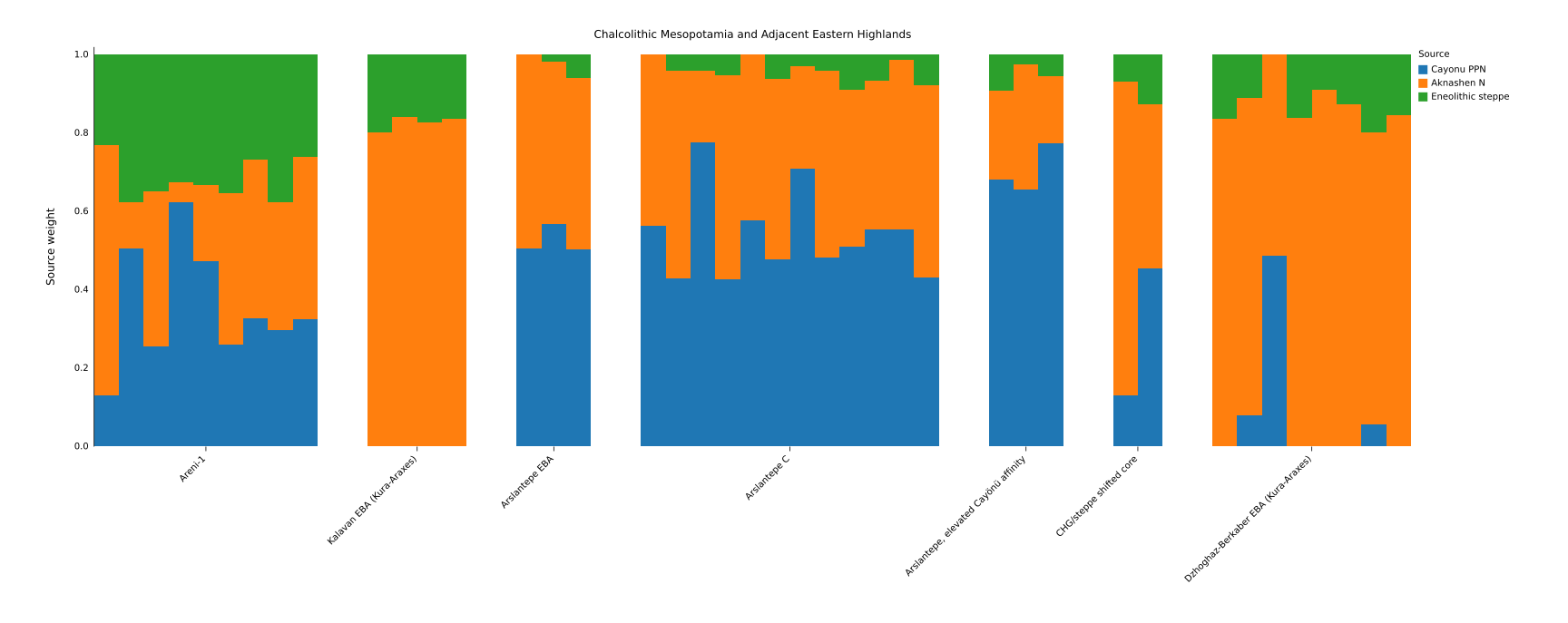
All 41 samples passed; none fell below the p-value threshold of 0.05. I kept the number of sources small to avoid introducing unnecessary complexity into the models.
Areni-1 averages around 31.1% Eneolithic Steppe ancestry (here represented by Progress-2 / PG2001), with the rest distributed in this model between Çayönü and the Aknashen Neolithic. Later Kura-Araxes samples show a rise in Caucasus Neolithic, Aknashen-like ancestry (~80%) and an overall decline in Eneolithic Steppe ancestry. Nevertheless, the Late Chalcolithic pottery at Areni-1 includes pottery with emerging Kura-Araxes traits, including black-burnished surfaces and characteristic vessel forms. The genetic evidence, however, does not suggest that the Kura-Araxes groups represented here were simply direct demographic continuations of preceding Chalcolithic populations such as Areni-1.
The Kura-Araxes horizon is also often connected to the dispersal of the Proto-Hurro-Urartian languages, but the major Hurrian political centre of Urkesh (Tell Mozan) seems to challenge this simplified dispersal model. Urkesh is clearly identified as Hurrian from the third millennium BCE, but its ceramic tradition is mostly rooted in northern Mesopotamian traditions such as Ninivite V and Metallic Ware, while Kura-Araxes pottery is described as very rare at the site. Early Hurrian Urkesh also does not simply resemble a transplanted Kura-Araxes settlement in the Upper Khabur.
Areni-1, on the other hand, seems directly relevant to the question of the origins of Proto-Anatolian-speaking groups and their later dispersal westward from eastern Anatolia. As can be seen, Eneolithic Steppe ancestry is consistently present across the Areni-1 group, making the site particularly relevant to this discussion.
Chalcolithic Arslantepe appears to have a stronger Çayönü-related ancestry component in this model, with ART015, ART024, and ART023 each scoring above 70% for this component. Also relevant to the question of the Proto-Anatolians is the presence of Eneolithic Steppe ancestry at Chalcolithic Arslantepe. The only apparent outlier in this setup is ART018, which shows elevated Aknashen-like ancestry.